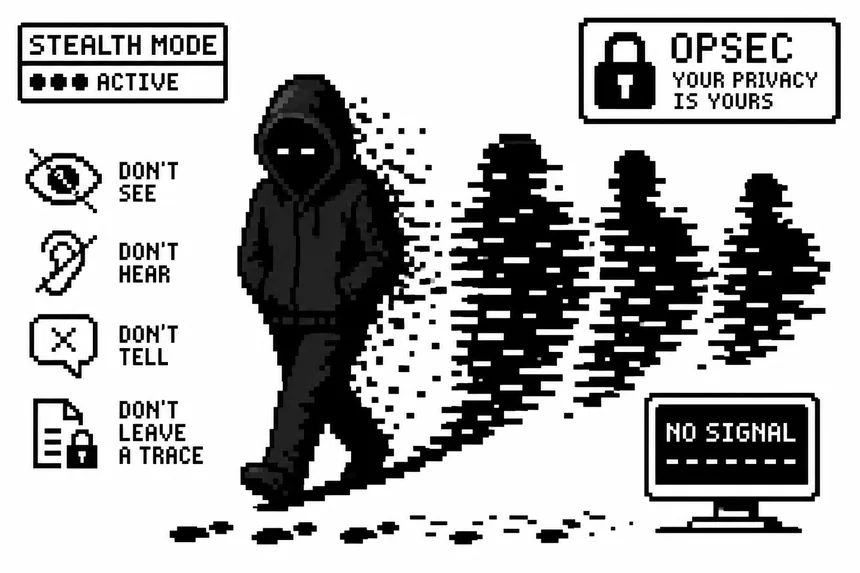
Basic OPSEC — use Tor, use Monero, use unique usernames — is now well-documented and practiced by many darknet participants. Advanced OPSEC addresses the next tier of threats: the behavioral and metadata-based attribution techniques used against targets who have already addressed the technical basics. This article covers four advanced threat categories that are increasingly relevant in 2026.
Behavioral Fingerprinting
Behavioral fingerprinting is the process of identifying individuals through patterns in their online behavior rather than technical identifiers. Even with technical anonymity intact, behavioral patterns can link personas across platforms or over time:
- Login timing patterns: If a person consistently logs into a darknet market between 9pm and 11pm in a particular time zone, this pattern provides a strong signal about their location and routine.
- Activity cadence: The rhythm of posting frequency, response times, and inactivity periods creates a behavioral signature. A persona that goes quiet every Sunday afternoon and every third Monday creates a correlation opportunity.
- Error patterns: Consistent typos, autocorrect artifacts, or device-specific keyboard shortcuts appearing in messages across platforms can link them to the same author.
Mitigation: vary login times, introduce deliberate noise into behavioral patterns, and avoid establishing predictable routines that correlate across sessions or platforms.
Stylometry and Writing Style Analysis
Stylometry is the computational analysis of writing style to identify authorship. Modern stylometric tools analyze hundreds of features: sentence length distribution, vocabulary richness, function word frequency, punctuation habits, and more. Research has shown that stylometric analysis can identify authors with significant accuracy from as few as 1,000 words of text.
Law enforcement and intelligence agencies have applied stylometric analysis to link darknet forum posts to clearnet writing — academic papers, blog posts, social media, even code comments — in documented investigations. The attacker only needs sufficient text samples from both the anonymous and identified personas to perform correlation.
Mitigation strategies:
- Write differently in operational contexts than in personal life — use different sentence structures, vocabulary level, and punctuation habits
- Avoid technical jargon or specialized vocabulary that appears in identified writing
- Minimize post length in operational contexts (less text means fewer stylometric features to analyze)
- Use tools like Anonymouth (a stylometric anonymization research tool) to identify distinctive features of your writing
EXIF Metadata in Images
Digital images contain EXIF metadata — embedded data recording camera model, exposure settings, GPS coordinates (if location services were enabled), and timestamp. Sending or posting images from a real device without stripping metadata can expose precise location, device model, and the exact time the photo was taken.
Even without GPS data, camera model information can be correlated with device purchase records or other images posted under a real identity. Mitigation: strip all EXIF data before sharing any image in an operational context. ExifTool (command-line), various mobile apps, and image editing tools provide EXIF stripping capability.
Compartmentalization Principles
Compartmentalization is the principle of strict separation between operational personas and real identities, with no shared infrastructure, devices, accounts, or behavioral patterns. A complete compartmentalization model includes:
- Separate hardware (or at minimum, separate operating system instances) for operational and personal use
- No operational activity on devices or networks connected to real identity accounts
- Separate email accounts, PGP keys, and usernames for each distinct operational context
- No personal topics discussed in operational contexts; no operational topics in personal contexts
Advanced Threat Model Assessment
Not all users face the same threat model. A casual researcher faces different risks from a high-value target of a national-level law enforcement investigation. Advanced OPSEC measures require significant operational overhead — the investment is justified proportionally to the realistic threat. Conducting a realistic threat model assessment (who wants to identify you, what resources do they have, what links currently exist) is the starting point for prioritizing which advanced measures are actually necessary.
For foundational OPSEC, see the full OPSEC on Torzon guide. Advanced techniques build on basics that must be addressed first.