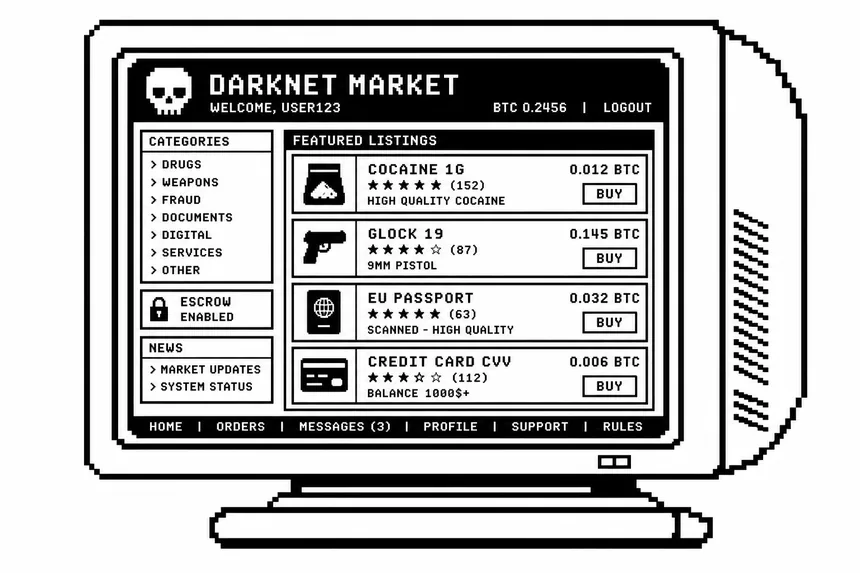
The Torzon darknet market represents one of the more technically mature architectures in the current darknet marketplace ecosystem. Based on publicly available research and community documentation, this article provides an overview of how the platform structures its core systems — from onion addressing to escrow mechanics — purely for informational and educational purposes.
V3 Onion Addressing and Network Access
Torzon operates exclusively through v3 onion addresses, the current standard in the Tor network. V3 addresses use a 256-bit public key derived from an Ed25519 keypair, producing 56-character .onion domains. This is a significant security improvement over the deprecated v2 format, which used only 80-bit truncated SHA-1 hashes and was vulnerable to brute-force enumeration attacks.
The v3 format provides cryptographic authentication by design: a client connecting to a v3 address can verify it is communicating with the legitimate service without relying on any third-party certificate authority. This eliminates a major class of man-in-the-middle attacks that affected earlier onion service versions. Torzon maintains multiple v3 addresses as redundancy against seizure or DDoS attacks, a common operational practice among well-maintained darknet services.
Escrow Architecture
The escrow model employed by Torzon follows the standard custodial escrow pattern widely used across darknet markets. When a buyer initiates a purchase, funds are transferred to a platform-controlled wallet address rather than directly to the vendor. The escrow holds these funds until one of three outcomes: the buyer confirms delivery, an auto-finalization timer expires, or a dispute is raised and resolved by platform moderators.
- Standard Escrow: Funds held by the platform until buyer confirmation or auto-finalization
- Auto-Finalize (AF): Funds release automatically after a set period without dispute
- Finalize Early (FE): Buyer releases funds immediately; only recommended for extensively verified vendors with high trust scores
The risk profile of custodial escrow is important to understand: the platform holds funds, meaning a platform-level exit scam or seizure can result in loss. This is why experienced researchers recommend limiting escrow exposure and never finalizing early with unknown vendors.
PGP Encryption Requirements
Torzon enforces PGP encryption for all order-sensitive communications. Vendors are required to publish their public PGP keys on their profile pages, and buyers are expected to encrypt shipping address information before transmission. This means even if a platform server is compromised — whether by law enforcement seizure or unauthorized intrusion — the plaintext content of communications remains inaccessible without the corresponding private keys held by individual parties.
The practical implementation of mandatory PGP is a meaningful security distinction. Markets that do not require PGP expose buyer shipping data as plaintext on their servers. Under the Torzon model, a complete server compromise yields only ciphertext for address fields, substantially limiting the intelligence value of such an operation.
Vendor Feedback and Rating System
Reputation on Torzon is built through a transaction-weighted feedback system. After order completion, buyers can leave ratings and written reviews. The system weights feedback by transaction volume — a vendor with 500 completed transactions and a 98% positive rate carries significantly more trust signal than a new vendor with 10 transactions at the same percentage. This design reduces the effectiveness of sybil attacks, where an adversary creates multiple fake buyer accounts to artificially inflate a vendor's score.
Vendors accumulate trust levels over time, with each level unlocking additional platform capabilities. Research suggests that the bond requirement — a deposit made at registration — combined with progressive trust levels creates meaningful friction against fraudulent vendor accounts.
Registration and Access Security
New user registration on Torzon follows a standard darknet market pattern: username selection, password creation, and optional PGP-based two-factor authentication (2FA). PGP-based 2FA requires the user to decrypt a challenge encrypted to their public key before access is granted, providing a second authentication factor that does not rely on SMS or TOTP and is therefore resistant to SIM-swapping attacks.
All information in this article is based on publicly available community research. This site does not facilitate or endorse darknet market activity. Access and use of darknet markets may be illegal in your jurisdiction.
Summary
The Torzon architecture combines industry-standard darknet market practices — v3 onion addressing, custodial escrow, mandatory PGP, and transaction-weighted reputation — into a coherent security model. Understanding this architecture is valuable for researchers, journalists, and security professionals analyzing the darknet marketplace ecosystem.