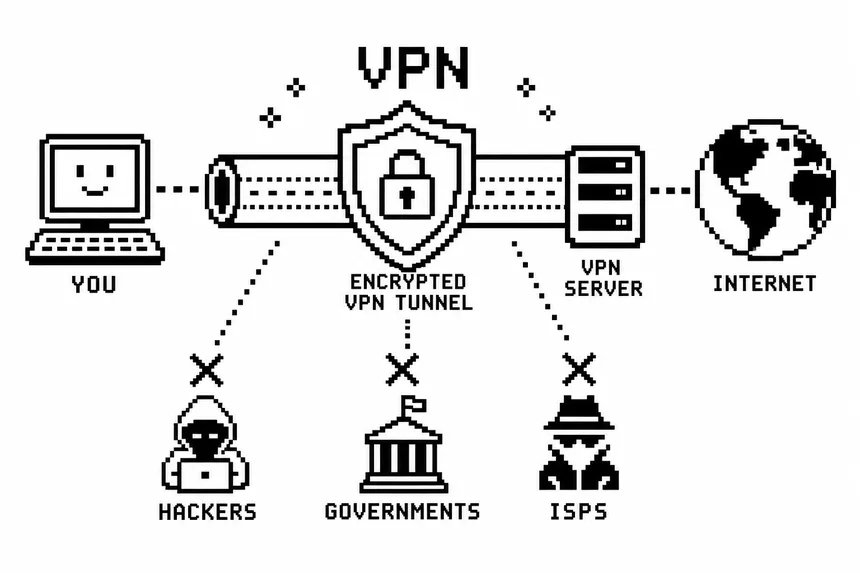
The question of whether to combine a VPN with Tor is one of the most frequently debated topics in darknet privacy research. The answer is not universal: it depends on your specific threat model, the VPN provider's trustworthiness, and which configuration you choose. This article provides a structured analysis of both configurations and their respective use cases.
Configuration 1: Tor Over VPN (VPN then Tor)
In this configuration, you connect to a VPN first, then use Tor on top of the VPN connection. The VPN server sees your Tor traffic but cannot see its content or destination. Your ISP sees only VPN traffic, not that you are using Tor.
When this is useful: In jurisdictions where Tor usage is itself suspicious or ISP-level Tor blocking is in effect. The VPN hides the fact that you are connecting to the Tor network. This is also the configuration provided by Tails OS when using a VPN bridge.
Risks: The VPN provider becomes a trust anchor. If the VPN keeps logs (despite claiming otherwise), or is compelled to produce them, your connection to the Tor network is documented. You are replacing ISP trust with VPN provider trust. "No-log" claims by VPN providers have been disproven in multiple documented cases where providers cooperated with law enforcement.
Configuration 2: VPN Over Tor (Tor then VPN)
In this configuration, you route through Tor first, then connect to a VPN from within the Tor exit. The VPN server sees a Tor exit node address as your "IP." The destination site sees the VPN's IP address rather than a Tor exit node.
When this is useful: When accessing clearnet services that block Tor exit nodes (many do), while still wanting IP-level anonymity at the destination. Also allows persistent VPN IP across sessions, which may be needed for certain account-based services.
Risks: This configuration requires using a VPN that accepts Tor connections, and it provides no benefit for .onion service access (which already terminates within the Tor network). The VPN becomes a potential log source for the destination IP you connected to after Tor exit, which it can see even without seeing your real IP.
Pure Tor: Often the Best Option for Darknet
For accessing .onion services specifically, neither VPN configuration provides a meaningful privacy benefit over pure Tor. Onion services do not involve an exit node — the circuit terminates within the Tor network, and neither endpoint's IP is exposed. Adding a VPN introduces an additional trust dependency without improving anonymity against the primary threat model (the .onion service operator or Tor network-level attacker).
The Tor Project's official guidance is that Tor alone is sufficient for .onion service access and that combining with a VPN adds complexity without commensurate benefit in most threat models.
VPN Limitations and No-Log Claims
No-log VPN claims warrant skepticism. A VPN provider is a business subject to the laws of the jurisdiction in which it operates. Legal processes, including court orders and national security letters, can compel providers to produce records regardless of their stated policy. Multiple providers that marketed themselves as "no-log" have been proven to have cooperated with law enforcement when investigated. The structural limitation is that a user cannot verify a no-log claim — it is based entirely on trust in the provider.
Summary: Configuration Decision Matrix
| Use Case | Recommended Configuration |
|---|---|
| Accessing .onion services anonymously | Tor Browser (pure Tor) |
| Hiding Tor use from ISP | VPN then Tor, or Tor bridges |
| Accessing Tor-blocked clearnet sites | Tor then VPN |
| Maximum anonymity (best practice) | Tails OS with pure Tor |