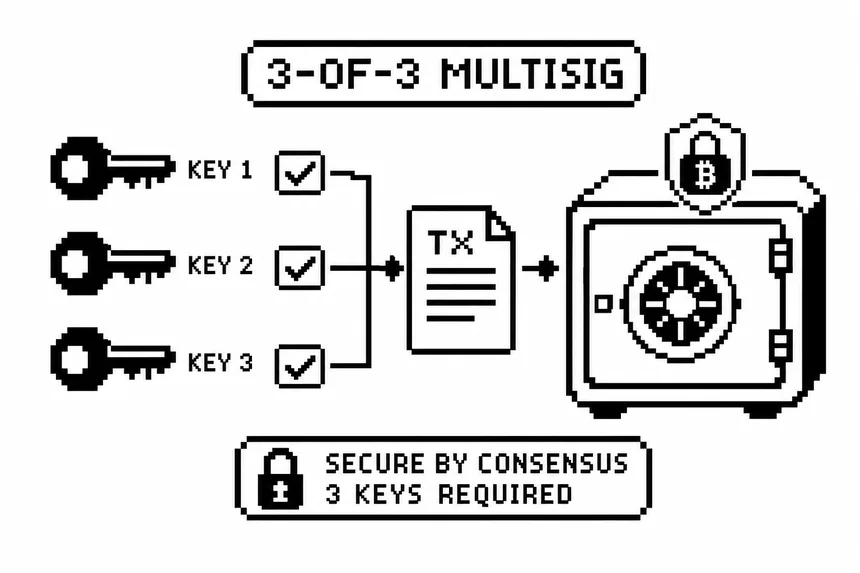
Multisignature (multisig) escrow represents a significant security improvement over traditional custodial escrow in darknet marketplace transactions. Rather than trusting a single party — the marketplace — to hold and release funds, multisig distributes cryptographic control across three parties such that no single party can unilaterally move the funds. This article explains the technical foundation and practical implications.
Bitcoin Script and Multisig Basics
Bitcoin transactions are governed by a scripting language that defines the conditions under which funds can be spent. A standard single-key transaction requires one signature from the holder of the private key corresponding to the address. Multisig transactions require signatures from a specified number of keys out of a total set — hence "M-of-N" notation.
A 2-of-3 multisig transaction requires exactly 2 valid signatures from a set of 3 designated public keys to authorize a spend. The three keys are typically held by: the buyer, the vendor, and the marketplace (acting as arbitrator). Funds are sent to a P2SH (Pay-to-Script-Hash) or P2WSH (Pay-to-Witness-Script-Hash) address derived from the multisig script, and only a combination of 2 of the 3 keys can release them.
How the Transaction Flow Works
- Order initiation: The buyer, vendor, and market each generate a public key for the transaction. A multisig address is derived from these three public keys.
- Buyer payment: The buyer sends BTC to the multisig address. The funds are now cryptographically locked — none of the three parties can move them alone.
- Successful order: The buyer and vendor both sign the release transaction. With 2 of 3 signatures (buyer + vendor), the funds transfer to the vendor without any market involvement required.
- Disputed order: If buyer and vendor disagree, either party escalates to the marketplace. The market reviews evidence and signs the release transaction either with the buyer (2-of-3: market + buyer = refund) or with the vendor (2-of-3: market + vendor = release). The market's signature alone is insufficient — it can only act as a tie-breaker.
Why Multisig Eliminates Exit Scam Risk
In custodial escrow, market administrators control the escrow wallets directly. If administrators choose to exit scam, they can drain all funds in escrow at will. In multisig, the market holds only one of three keys. Even if administrators attempt to abscond with funds, they can only sign one transaction — insufficient to release the funds without the buyer or vendor cooperating.
This property means multisig escrow is structurally resistant to the single largest financial risk in darknet market participation: platform-level exit scams. The market can facilitate disputes and act as arbitrator but cannot steal funds unilaterally.
Current Implementation Landscape
True 2-of-3 multisig requires that both buyer and vendor hold their private keys locally — a technical requirement that creates onboarding friction. Simplified implementations include "buyer-only multisig," where only the buyer holds a local key and the market holds the other two, providing some protection against unilateral market theft while reducing complexity. Full 2-of-3 implementations are increasingly available on technically mature platforms.
Buyer and Vendor Perspective
For buyers, multisig means they must manage a private key locally, adding a step to the transaction process. The tradeoff is significantly reduced exposure to platform-level exit scam risk. For vendors, multisig means the market cannot interfere with releasing their earned funds without cause — and disputes can only be settled with both the market and either the buyer or vendor in agreement.
While multisig significantly reduces exit scam risk for individual transactions, it does not eliminate all risks. Vendor-level fraud (shipping counterfeit or no goods) and platform downtime still affect users regardless of escrow type.