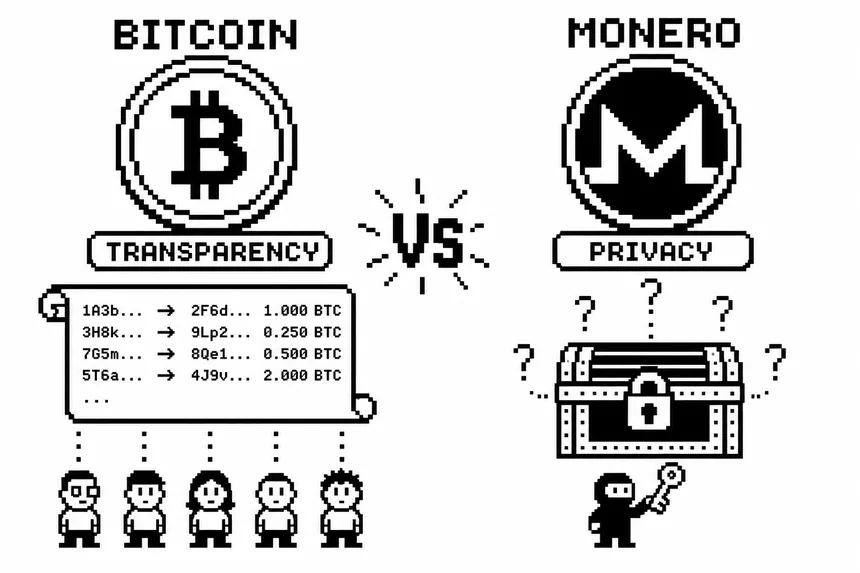
The choice between Bitcoin and Monero for privacy-sensitive use cases is not merely a preference decision — it reflects fundamentally different cryptographic architectures with different privacy guarantees. This technical comparison examines both protocols in depth to explain why the privacy research community consistently recommends XMR over BTC for contexts where financial privacy is a requirement.
Bitcoin: The Transparent Ledger
Bitcoin's blockchain is a publicly accessible, permanent record of every transaction ever made. Key properties that undermine privacy:
- Address visibility: Sender and recipient addresses for every transaction are visible to anyone. While addresses are pseudonymous (a string of characters rather than a name), they can be linked to identities through multiple vectors.
- Amount transparency: Transaction amounts are fully visible. This enables "taint analysis" — tracing funds by following them through addresses even when they pass through multiple hops.
- UTXO clustering: When multiple unspent transaction outputs (UTXOs) are combined in a single transaction input, they are inferred to belong to the same wallet. This common-input-ownership heuristic is the basis of address clustering algorithms.
- Transaction graph analysis: The full transaction history of any address is permanently queryable. A single identified address can expose an entire transaction history reaching back to the wallet's first use.
How Analytics Firms Trace Bitcoin
Blockchain analytics firms like Chainalysis, Elliptic, and CipherTrace operate by combining UTXO clustering, OSINT (open-source intelligence), exchange KYC data obtained through legal process, and proprietary address tagging to map addresses to identities or entity types (exchange, mixer, darknet market). When law enforcement obtains a KYC-verified exchange account linked to the same address cluster as a market wallet, the investigative connection is established.
The effectiveness of these tools has been demonstrated repeatedly in legal proceedings, where Bitcoin transaction records have been presented as evidence in darknet-related prosecutions. The permanent nature of the blockchain means that even transactions made years in the past can be analyzed with future improvements in analytics tooling.
Monero: Privacy by Default
Monero's design inverts Bitcoin's model. Rather than requiring users to implement privacy techniques on top of a transparent protocol, Monero provides cryptographic privacy guarantees at the protocol level for all transactions:
- Ring signatures obfuscate the sender among a set of decoys. The default ring size of 16 means any input has 15 plausible alternatives.
- Stealth addresses ensure recipients cannot be linked across transactions on the blockchain. Each receipt uses a unique one-time address.
- RingCT hides transaction amounts using Pedersen commitments while still allowing mathematical verification that no XMR is created from nothing.
The Hybrid Approach Risk
Some users attempt to use both BTC and XMR, converting between them at swap services. This approach carries significant risk if not implemented correctly. Any conversion that passes through a KYC-verified exchange creates a linkage point. Decentralized atomic swaps (direct BTC-to-XMR swaps without custodian) avoid this risk but require technical sophistication. Converting at a centralized exchange — even a no-KYC exchange — creates server-side records that may be obtained through legal process.
Practical Recommendation
For use cases where financial privacy is genuinely required, the research consensus is unambiguous: Monero provides cryptographic privacy guarantees that Bitcoin cannot match without complex and imperfect add-on techniques. BTC mixing, CoinJoin, and Lightning Network all reduce traceability but none provide the same level of guaranteed obfuscation as Monero's base protocol. Users who require privacy should obtain XMR directly and avoid converting from BTC wherever possible.
| Property | Bitcoin (BTC) | Monero (XMR) |
|---|---|---|
| Sender privacy | None (pseudonymous) | Ring signatures (strong) |
| Recipient privacy | None (pseudonymous) | Stealth addresses (strong) |
| Amount privacy | Fully visible | RingCT (hidden) |
| Analytics traceability | High | Low (no production tool) |