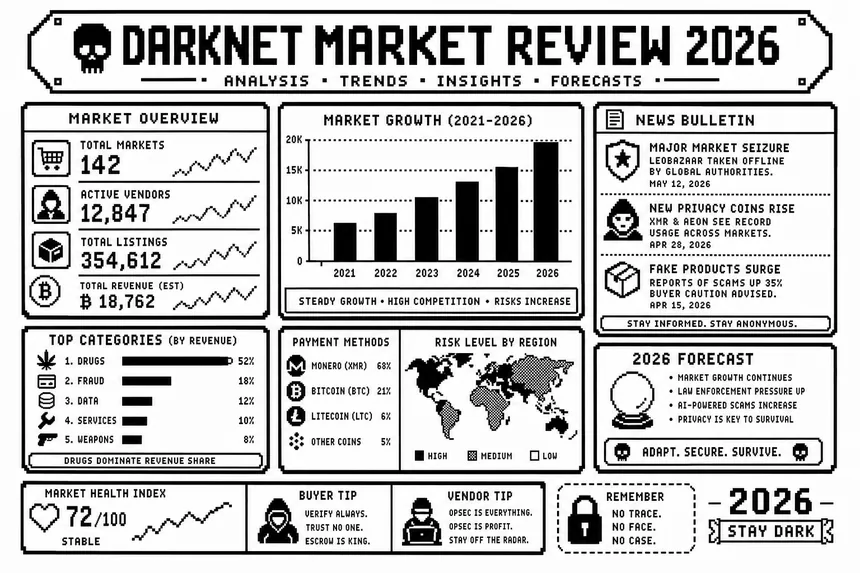
The mid-2026 state-of-the-market report provides a comprehensive snapshot of the darknet marketplace ecosystem following several years of significant change. This analysis covers major platform developments, the regulatory and law enforcement environment, technology adoption trends, and the outlook for the remainder of 2026. It is published for research and informational purposes only.
Platform Landscape
As of April 2026, the darknet market sector is characterized by a small number of dominant established platforms and a continuous flux of smaller entrants. The top platforms by estimated user registration and transaction volume have been operating for multiple years, demonstrating the survival premium that accrues to platforms with established security track records.
Key developments in the platform landscape since 2025:
- Two previously mid-tier platforms have exited operations — one through apparent voluntary closure with advance notice, one through a suspected exit scam. The voluntary closure included a structured wind-down period, which represents an improvement in platform stewardship over historical abrupt exits.
- Several new platforms launched with multisig escrow as a default feature, reflecting increased user demand for this security property following 2024 and 2025 exit scam events.
- Platform operator transparency has increased marginally — more platforms now publish regular canary statements and security audit summaries.
Regulatory Environment
The regulatory environment for darknet markets in 2026 reflects continued international coordination between law enforcement agencies. Key developments:
- The EU's expanded digital asset tracking requirements have increased pressure on exchanges operating in European jurisdictions to implement stricter KYC and transaction monitoring, indirectly affecting darknet market participants who convert cryptocurrency at European exchanges.
- US federal coordination under DOJ and DHS continues to focus on high-volume vendor operations rather than platform infrastructure attacks, as vendors are typically the higher-value investigative target with more actionable physical evidence.
- Monero delistings from major regulated exchanges have continued, though peer-to-peer and decentralized exchange infrastructure for XMR has expanded to compensate.
Technology Trends
Several technology trends are shaping the 2026 darknet market environment:
- Multisig adoption acceleration: The combination of high-profile exit scams and available technical tutorials has driven multisig adoption to approximately 30% of tracked platform transactions, up from ~10% in 2024.
- Monero dominance: XMR now accounts for an estimated 70-75% of darknet transaction volume, with that share projected to continue growing.
- Onion service infrastructure hardening: Multiple v3 onion addresses per platform, improved DDoS resistance through Tor network engineering improvements, and decentralized platform backends are increasingly standard.
- Harm reduction integration: Several platforms have integrated harm reduction resources directly into their interfaces — drug information databases, fentanyl test strip information, and overdose response guidance — reflecting both user demand and platform operators' harm reduction commitments.
Privacy Coin Adoption Outlook
The trajectory for privacy coin adoption within darknet markets is strongly positive entering the second half of 2026. Monero's protocol continues to improve with each fork, and the absence of a production-grade tracing tool keeps its privacy guarantees credible. Bitcoin's role in darknet transactions is projected to continue declining as analytics tooling improves and as Monero liquidity improves through decentralized exchange infrastructure.
Summary Assessment
The darknet market ecosystem in 2026 is more technically mature, more privacy-focused, and more resilient to single points of failure than at any previous point in its history. The consolidation of activity around established platforms with verifiable security histories reflects rational risk management by participants. The primary risk factors remain platform-level exit scams, law enforcement infiltration operations, and vendor-level OPSEC failures — all of which are addressable through established best practices documented in research guides like those available on this site.
This analysis is based on publicly available information and is published for research and educational purposes only. Estimated figures are derived from monitoring services and publicly available data and should be treated as approximations.