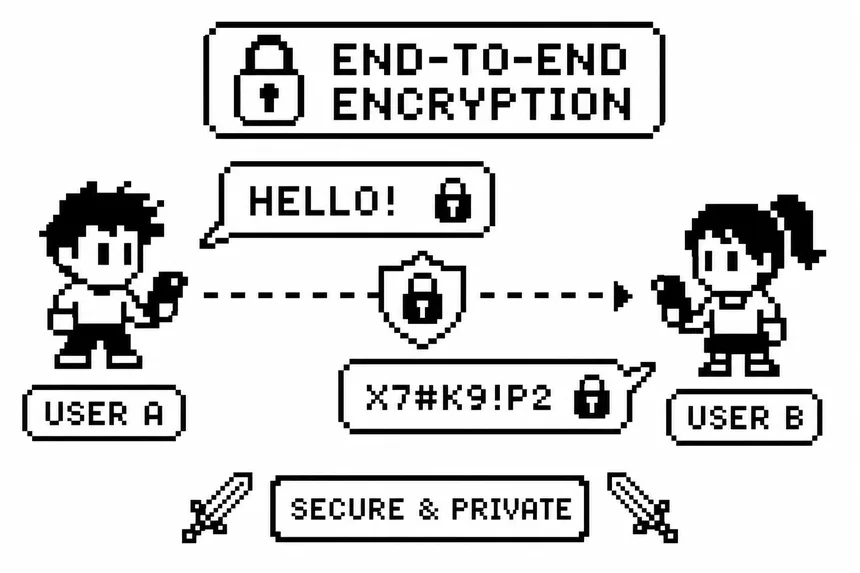
Encrypted communications tools are foundational to any serious privacy or security practice. However, encryption is not a monolithic property — different tools provide different guarantees, protect against different threats, and are appropriate for different use cases. This article compares the primary encrypted communication options relevant to darknet users: PGP, Signal Protocol, and Matrix/Element.
PGP: The Darknet Standard
Pretty Good Privacy (PGP) has been the standard for secure darknet communication since the earliest marketplace operations. Its strengths are well-understood:
- Asynchronous encryption: A message encrypted to a public key can be decrypted only by the holder of the corresponding private key. The sender and recipient do not need to be online simultaneously.
- Long-term key identity: A PGP key pair serves as a stable identity anchor. Vendors publish their public keys on market profiles; buyers verify that messages from those vendors are signed by the same key.
- No server dependency: PGP encryption happens locally. There is no server that can be compelled to produce plaintext message content, because the server (the darknet market) stores only ciphertext.
- Offline capability: Encrypted PGP messages can be composed and decrypted entirely offline, with no network exposure during the cryptographic operations.
PGP's weakness is usability: key management, the web of trust model, and command-line tools present a barrier to entry. For communications between market participants, PGP remains the appropriate tool.
Signal Protocol: Modern Messaging Security
The Signal Protocol (used in Signal, WhatsApp, and many other messaging apps) provides end-to-end encryption with several properties that PGP lacks:
- Forward secrecy: Signal uses ephemeral key exchange (Double Ratchet algorithm) that generates a new encryption key for each message. Even if a long-term key is compromised, past messages cannot be decrypted.
- Deniability: Signal messages are designed to be cryptographically deniable — it is not possible to prove to a third party that a specific person sent a specific message, unlike PGP signatures which provide strong attribution.
- Synchronous design: Signal is optimized for real-time conversation between parties who share phone numbers or Signal identifiers.
The critical limitation for darknet use: Signal requires a phone number for registration (though this can be a VoIP number). Signal is a clearnet application — communications route through Signal's servers, providing traffic metadata (who communicates with whom, when, how often) even if message content is encrypted. Signal is appropriate for communications between trusted parties where metadata exposure is acceptable; it is not a replacement for PGP in darknet market contexts.
Matrix/Element for Group Communications
Matrix is a decentralized, federated messaging protocol with end-to-end encryption (using the Signal Protocol's Megolm algorithm). Element is the reference client. Key properties:
- Federated architecture: messages route through the sender's homeserver, which may be self-hosted, reducing reliance on any single corporation's infrastructure
- Persistent rooms: unlike Signal, Matrix supports large group rooms with message history
- Tor-accessible: Matrix servers can be accessed via Tor, and Element has configuration options for Tor routing
Matrix/Element is appropriate for group discussions among trusted communities where end-to-end encryption and reduced centralization are priorities. It does not provide the same metadata protection as communications entirely within the Tor network.
Metadata: The Overlooked Threat
The most significant limitation of all end-to-end encrypted messaging tools is that encryption protects content but not metadata. Metadata includes: who communicated with whom, when, how frequently, for how long, and from what IP addresses. Even with perfect content encryption, metadata analysis can reveal the structure of a social network, identify key individuals, and establish behavioral patterns.
For darknet use cases, the implication is that Signal and Matrix communications generate clearnet metadata that can be obtained through legal process. Only communications that occur entirely within the Tor network — market messaging systems, Tor-accessible XMPP servers, or similar — avoid this metadata leakage. PGP used within a Tor-connected market interface provides the strongest combination: content encryption with no clearnet metadata.
Tool Selection Summary
| Tool | Best Use Case | Key Limitation |
|---|---|---|
| PGP via market | Vendor-buyer order communications | Usability; no forward secrecy |
| Signal | Trusted 1-on-1 communication | Phone number; clearnet metadata |
| Matrix/Element | Group community communications | Homeserver metadata; clearnet routing |